
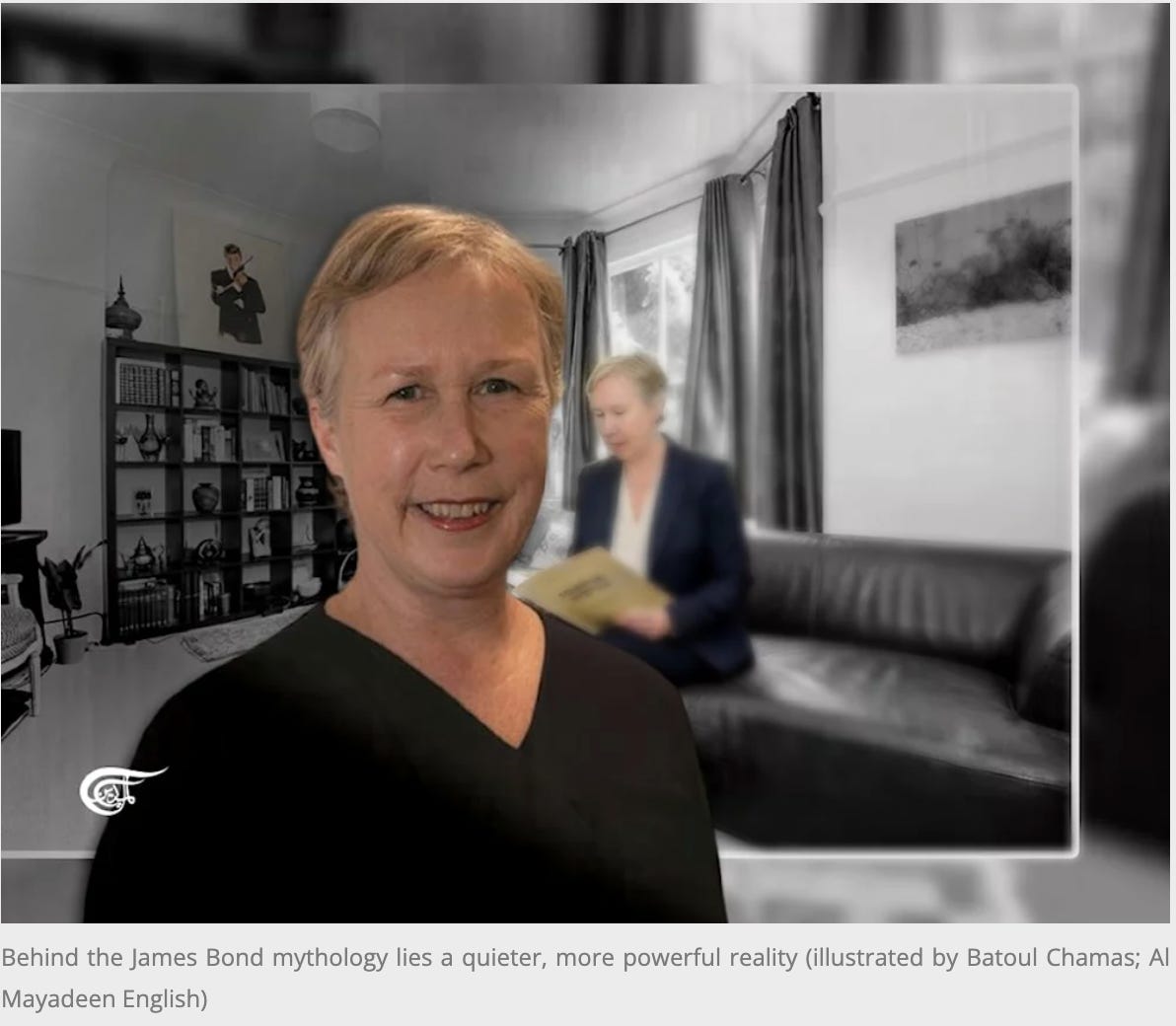
We love to buy into the cinematic illusion of the British secret service. We giggled along when former MI6 operative Christopher Steele introduced himself at the Cambridge Union, with an ostentatiously boastful “The name’s Steele, Christopher Steele” while clad in a dinner jacket and wearing a signature James Bond Omega watch. It was a juvenile, vainglorious performance designed to satisfy a public appetite for glamour, but it masks a far more chilling reality about the people we employ to run the modern national security state.
True, high-consequence state power doesn’t flaunt itself in a bespoke dinner jacket. It doesn’t necessarily graduate from Oxford or Cambridge. Instead, it hides behind the bloodless vocabulary of corporate management, operating out of flat-packed IKEA shelves in leafy London suburbs.
Staging the suburban counter-masque
Consider a concrete case study in institutional camouflage. Prior to joining MI6, one rising star spent years writing an academic PhD thesis on the power of the Stuart court masque at Liverpool University. Her academic research showed that the 17th-century monarchy used highly expensive, theatrical multimedia spectacles—where royals stepped onto stages dressed as gods—to project the absolute illusion of divine power, while the real, factional subversion was negotiated entirely behind the curtain.
When this Catholic grammar school-girl from Birkenhead who attended first Nottingham and then Liverpool University climbed the ranks of an historically insular, Oxbridge-dominated intelligence pipeline, she weaponized this exact theory.
During her mid-career window from 2005 to 2016, she owned a modest, 750-square-foot, two-bedroom ground-floor conversion on Canonbie Road in Forest Hill, South East London.

44 Canonbie Road, Forest Hill, London in 2016.
If you were to peer through the bay windows of that ordinary, slightly overgrown suburban semi-detached converted flat, your eyes would be drawn straight to a large, framed poster of Roger Moore in a promotional image for The Spy Who Loved Me sitting prominently atop a black Kallax IKEA bookcase.

Portrait of a Spy at home
To the casual observer, this decor might look like naff tourist kitsch. But was it a calculated piece of modern staging?
For a grammar school girl of Irish heritage navigating the upper echelons of MI6 in the 2000s, British establishment symbols carry immense psychological weight. Historically, the British intelligence apparatus viewed Irish roots and Catholicism with deep institutional suspicion.
Placing a Union Jack cushion on her armchair smacks of a distinct, defensive desperation to please. Even if it was bought with a hint of tongue-in-cheek, “Cool Britannia” irony, it functions as a glaring, overcompensating badge of loyalty. It screams to any visiting colleague or senior official: “Look, I am completely safe, aligned, and dedicated to the flag.” It is the classic behaviour of a double-outsider trying to fit into a traditionally Anglican, independent-school, Oxbridge network.
Ultimately, however, the simplest explanation is the most devastating: her taste was just thoroughly unoriginal. Having a PhD on 17th-century power dynamics or managing high-altitude geopolitical risk does not magically grant someone sophisticated aesthetic judgment.
The flat-packed IKEA shelves, the cheap holiday souvenirs, and the corny Hollywood memorabilia tell a story of an ordinary, basic middle-class lifestyle. Here we have a compliant, upwardly mobile bureaucrat who went to work to manage expansive state machinery by day, and came home to sit among mundane, slightly naff suburban clutter by night.
The ultimate camouflage for a modern operative isn’t an uncrackable cipher. It is the overwhelming, undeniable aura of being completely boring, middle-class, and ordinary, even if you are the child of Irish immigrants from Birkenhead. Is this what the integration of immigrants looks like?
The banality of managerial threat-making
This brings us to the ultimate, chilling framework of statecraft: Hannah Arendt’s concept of the banality of evil. Arendt observed that the most effective instruments of state violence are rarely ideological monsters, but rather unimpressive, compliant career bureaucrats obsessed with administrative efficiency.
This corporate blandness characterized the first, and so far only, public panel discussion delivered by Dr. Michelle Haslem, the current Director General of the Homeland Security Group at the Home Office. During the event, viewers expecting a profound demonstration of strategic vision will have been disappointed. They instead witnessed a deeply uninspiring lecture scrubbed entirely of human or moral weight. She spoke in a sterile, bloodless dialect, flattening complex human beings and geopolitical crises into corporate metrics like “threat systems,” “enablers,” “volume threats,” and even “how do we think about protection and preparedness in a more threat-agnostic way.”
But do not confuse this public un-impressiveness for a lack of capability. This dry, managerial exterior is exactly what makes her a terrifyingly effective instrument of the British establishment. This is a state official who spent 27 years operating across the UK, Europe, Asia, and the Middle East, executing counter-terrorism portfolios during an era when the UK clandestine services were repeatedly accused of direct complicity in war crimes, extraordinary rendition, and black-site unlawful detentions.
Today, she sits at the absolute “apex” – a word of which she is fond - of domestic power, directly commanding the Homeland Security Group. Her official mandate places her in absolute control of all UK counter-terrorism, responses to state threats, and economic crime.
The ‘humble background’ weaponized
What makes this new breed of civil service leadership uniquely dangerous is how their “outsider” backgrounds are utilized to legitimize state overreach. Much like MI5 Director General Ken McCallum - who frequently highlights his own Glasgow state school upbringing to project an approachable, meritocratic façade - Haslem’s redbrick, non-Oxbridge pedigree functions as a shield against public scrutiny. Aside from the commonality of not being Oxbridge graduates, McCallum and Haslem are in some ways an antonymic pair. She from Birkenhead – once the town with the highest proportion of Irish immigrants in the country - who attended a Catholic grammar school and then provincial universities studying English Literature. He, from a single-parent household (between the ages of 3 and 9), living in the leafy Broomhill district of Glasgow, son of a Protestant Minister, attended a ‘non-denominational’ (Read: Protestant), state school in Glasgow’s West End. He studied Maths at Glasgow University, joined MI5 at 20, and was then parachuted into the North of Ireland to infiltrate Irish Republican groups which rejected the Good Friday Agreement. Neither of them appears ever to have studied social science or even history proper – another commonality. Very different on the surface, but very similar in the end. Both servants of the rapacious beast that is British intelligence.
The institutional architecture of the deep state remuneration
This brings us to the quiet reality of Whitehall compensation. While Hollywood portrays intelligence chiefs as independently wealthy or driving luxury supercars, real state power operates within a strict, transparent bracket. As a Director General under the Senior Civil Service (SCS) Pay Band 3, Haslem falls squarely within the centrally managed Cabinet Office pay framework, which anchors base salaries for this tier between £130,000 and £208,100.
She sits on the same grade as the Chief of Defence Intelligence and the heads of the National Cyber Force and National Cyber Security Centre, and one below the five most senior spies of the UK “Grey Suit” network:
Sir Ken McCallum: The Director General of MI5, SCS4;
Blaise Metreweli: The Chief of the Secret Intelligence Service (MI6) (Known as “C”). SCS4;
Anne Keast-Butler: The Director of GCHQ. SCS4;
Adrian Bird: Chair of the Joint Intelligence Committee / Head of the Joint Intelligence Organisation (JIC / JIO) in the Cabinet Office. SCS4 [1, 2, 3]
Jonathan Powell (National Security Adviser - leading the National Security Council and National Security Secretariat. SCS4.
Graeme Biggar: Director General of the National Crime Agency (NCA) – Intelligence Command, which manages the UK’s National Economic Crime Centre and statutory intelligence tasks. SCS4. [The National Crime Agency is not technically part of the “intelligence community”, but its Intelligence Command is in practice strongly and increasingly integrated with the other bodies];
Michelle Haslem (Director General of HSG, formerly the Office for Security and Counter-Terrorism in the Home Office) Rank: SCS3 (Director General);
Lieutenant General Matthew Jones: Chief of Defence Intelligence. SCS3 Equivalent (Three-star military officer rank, matching a civilian Director General);
Richard Horne — Chief Executive Officer (NCF). SCS3 / Executive Tier. He is the public head leading the UK’s operational cyber defence.
Air Vice-Marshal Tim Neal-Hopes OBE — Commander, National Cyber Force NCF The joint GCHQ and Ministry of Defence offensive cyber organization (SCS3 / 3-star Military Equivalent);
Overall, it appears that the SCS4 ranks are likely paid a basic salary for more than £180,000 and the SCS3 ranks are likely paid around or more than £150,000 for their basic salary. Headline base salaries of £130k–£210k appear upper-middle class but not corporate-elite. However, the real wealth is quietly supplemented through the heavily guarded Civil Service Reward Scheme infrastructure:
Performance and Retention Bonuses: In addition to base pay, senior national security officials are routinely eligible for non-consolidated, tax-free corporate performance bonuses and secret “retention allocations” designed to prevent ‘talent’ from bleeding into private defence monopolies.
The Pension Contribution Anchor: The real financial prize is the staggering employer pension contribution rate. While a private sector executive might expect a 5–10% match, roles at Haslem’s level offer a massive 28.97% employer contribution standard into the Alpha Civil Service pension scheme—a back-end wealth accumulation asset that easily outstrips private executive packages.
Weaponizing the legislative state: The 2023 and 2026 acts
From this heavily insulated financial and suburban sanctuary, Haslem built her career. She now wields two devastating modern legislative instruments that are systematically dismantling civil liberties under the guise of safety: The National Security Act 2023 and the fast-tracked National Security (State Threats) Act 2026.
As Director General for Homeland Security, Haslem was one of the key administrative architects guiding these expansions through Whitehall, fundamentally shifting the state’s focus away from traditional policing toward permanent geopolitical panic:
The National Security Act 2023 vastly expanded state surveillance, introducing draconian new definitions of “foreign power threat activity” and granting police the power to detain individuals without charge under the sweeping banner of countering hostile state interference.
On July 8, 2026, the National Security (State Threats) Act 2026 received Royal Assent after being radically fast-tracked through Parliament. This law hands the Home Secretary unprecedented powers to unilaterally “designate” organizations as hostile foreign proxies—bypassing courts to make it a criminal offense carrying up to 14 years in prison to “support, assist, or obtain material benefit” from a designated group.
Under the quiet supervision of Haslem and her counterpart at MI5, Ken McCallum, these laws are being actively deployed to codify a permanent state of crisis. They weaponize counter-terrorism infrastructure to enforce structural anti-Muslim policing through the Prevent framework, while simultaneously manufacturing a nationwide panic against Russia, China, and Iran to criminalize political dissenters, journalists, and humanitarian NGOs.

Michelle Haslem’s home office and paper shredder
When you look back at that Canonbie Road floor plan, the layout is symbolic. The front reception room hosted the public masque—the Roger Moore poster, the books, and the business traveller souvenirs. But tucked safely around the corner, hidden in the narrowest, most insulated room of the flat, a home office, sat a Blue-and-Black Cross-cut Document Shredder, visible underneath the sofa.
That is the modern British security state in a single image. It doesn’t flash an Omega watch at a university debate. It quietly shreds its paper trail in a suburban back room, using the absolute banality of corporate compliance, a comfortable performance and retention bonus, and a public pension pot to manage immense, unaccountable global harm.
Starmer fits in very neatly.
The picture this description of people in the intelligence services presents to me is that of Mr or Mrs Bland who go shopping at Tesco's for cat food and who on the surface are harmless. Yet because of their indifference to those around them have, because of their view of their mission and the positions they hold in the establishment, the power to do tremendous damage to ordinary people. Am I wrong?