The Secret British Intelligence War on Iran

First published on UK Column, Thursday, 23rd April 2026
British intelligence spearheaded the overthrow of Iran’s elected prime minister in 1953, bribed officials, staged chaos and used the BBC for a coded coup signal — all to protect oil profits — after previously treating Zionist extremists as the top national security threat. Later and until today, they targeted the Islamic Republic of Iran and developed close collaborations with the Mossad.
1947: MI5 Saw Zionists as a Primary Threat
MI5 identified Zionist groups like Irgun and the Stern Gang as the primary national security threat to Britain in 1947, prioritising them over the Soviet Union. Declassified files confirm plots to assassinate officials including Foreign Secretary Ernest Bevin and fears that these groups would import ‘terrorist’ tactics to the UK mainland. And in fact the Zionists were pioneers of terror tactic in the first use of the book bomb — in a hollowed out copy of Shakespeare’s plays — which was sent in the post to a British military officer, Roy Farran, addressed to ‘R Farran’. His brother Rex opened the parcel and died from the injuries he sustained. MI5 also tracked Irgun terror networks across the country, including in Glasgow, where notable Zionist luminaries were implicated, including Maurice Bloch, the distiller, who ran the Glasgow Jewish Institute in the Gorbals. This is where the Irgun terror cell regularly met. Also implicated was Isaac Wolfson of the well-known Zionist Wolfson family, which today owns the Next retail chain. Isaac had been the special guest invited to open the Jewish Institute in 1935 and was close to Bloch. Another Wolfson — Isaac’s elder brother Samuel — had fought with Jabotinsky in the 1914-18 war in the Jewish Legion.
Both Bloch and Isaac Wolfson were implicated in the 1947-1948 Irgun spy scandal, and were called to provide evidence of their knowledge about the spy at the Lynskey Tribunal. Bloch was never charged with any offence, though his name was “erased from the list of Justices of the Peace for Glasgow” as a result. Wolfson was closely cross-examined over payments to the Irgun spy, Sidney Stanley, which were disguised by being split between three separate firms controlled by Wolfson. The focus of the investigation was on corruption, and as Christopher Andrew notes in his official history of MI5, the spying allegations were not raised at the Tribunal. It is unsurprising to note that the descendants of Isaac Wolfson are today centrally involved in the ‘charity’ pipeline, sending cash to the genocidal Zionist occupation forces via, for example, a charity called Beit Halochem. As in the 1920s and 1940s, the Wolfson family remain a threat to British national security.
1946: MI6 Fuels Iranian Tribal Unrest
MI6 encouraged uprisings among Iranian tribes in 1946 to pressure Tehran’s central government and safeguard British interests.
1951–1953: MI6 Leads Operation Boot to Topple Mossadegh
MI6 orchestrated Operation Boot to overthrow the democratically elected Prime Minister Mohammad Mossadegh after he nationalised the Anglo-Iranian Oil Company. Officer Christopher Woodhouse, head of the Tehran station, persuaded a reluctant CIA to join by framing it as anti-communist action. Norman Darbyshire ran MI6’s Persia station from Cyprus and directed the violent street uprising. In a recovered 1985 interview, Darbyshire stated, “My brief was very simple. Go out there, don’t inform the ambassador, and use the intelligence service for any money you might need to secure the overthrow of Mossadegh by legal or quasi-legal means”. He admitted spending “vast sums of money, well over a million-and-a-half pounds” on bribes, later claiming “The coup cost £700,000. I know because I spent it”.
MI6 deployed the Rashidian brothers as key agents for bribery and organising demonstrations.
Darbyshire explained that the operation involved bribing Majlis members, army officers, police, editors, and religious figures, while arming northern tribes. Psychological warfare included planting fake stories in Iranian newspapers, staging false-flag attacks on mosques blamed on the communist Tudeh party, and hiring mobs to create chaos.
BBC Broadcasts the Coded Coup Signal
The signal for the coup came via the BBC Persian service. On 8 August 1953, the announcer changed the usual midnight phrase from “It is now midnight in London” to “It is now exactly midnight”. The 19 August 1953 coup restored the Shah’s autocracy. MI6 later helped build SAVAK to suppress opposition, cementing decades of British subversion in Iran.
MI6-Mossad Ties Deepen After Kilowatt 1971
MI6 joined the Zionist entity’s Mossad in the Kilowatt network launched in 1971, which was an encrypted telex system linking 18 Western intelligence agencies including the CIA, the French DGSE, and the West German BND to share raw data on Palestinian militants. MI6 supplied granular intelligence on safe houses, vehicles, movements, and tactics, which Mossad used to track and assassinate Palestinians across Europe as part of Operation Wrath of God after the 1972 Munich massacre.
MI6 and British Government Scepticism Over Mossad Operations on UK Soil
MI6 expressed repeated doubts over Mossad’s rogue operations on UK soil. In 1987, after the Mossad-linked killing of Palestinian cartoonist Naji al-Ali in London, Margaret Thatcher shut down the whole Mossad station in Kensington, and expelled operatives Arie Regev and Yaacov Barad plus two other Israeli ‘diplomats’.
Former MI5 officer Annie Machon revealed that an internal MI5 assessment concluded Mossad carried out a controlled explosion to smear local Palestinian activists. The alleged motives were to secure heightened security around all Zionist interests in London (after MI5 had repeatedly refused Mossad requests) and to frame two innocent Palestinians — Samar Alami and Jawad Botmeh — who ran a growing pro-Palestine support network gaining political and financial traction in Britain. Despite possessing evidence of their innocence, MI5 allowed the pair to be convicted and imprisoned, effectively dismantling the entire Palestinian advocacy network.
In 2010, after the Zionist entity’s Mossad used forged British passports in the Dubai assassination of Hamas leader Mahmoud al-Mabhouh, Foreign Secretary David Miliband expelled a senior Mossad officer from the Israeli embassy. Miliband stated there were “compelling reasons to believe that Israel was responsible” for the misuse of UK passports, and amended travel advice to warn British citizens against handing passports to Zionist officials.
Despite these tensions, MI6 continued to ramp up joint operations against Iran, including intelligence support for the assassination of Iranian nuclear scientists between 2010 and 2012, as we shall see.
Early 1990s: MI6 Alleged Supply of Chemical and Nerve Agent precursors to Insert Agents into Iran
MI6 reportedly helped supply Iran with materials it could plausibly claim could be used to make chemical weapons in the early 1990s, despite Britain’s own ban on such sales. The operation was conducted with the Mossad, and aimed to insert British and Zionist operatives into the Iranian Government and gather intelligence on its weapons programmes. Former MI6 officer Richard Tomlinson claimed he personally obtained high-level government approval for the deals, which included components alleged to be for the production of mustard gas and nerve agents.
Tomlinson’s testimony was used by “lawyers of the jailed Israeli businessman Nahoum Manbar, who was sentenced for 16 years in Israel last July for his part in selling chemicals and technology for manufacturing poison gas weapons to Iran, through a network including British-based associates”. Manbar appealed against the sentence, and a key part of his defence was:
… based on testimony from Tomlinson claiming that MI6 and Mossad, the Israeli intelligence agency, were involved in these top secret operations.
According to an Israeli newspaper, his statement claims the British and Israeli intelligence agencies authorised Manbar to proceed with the chemical weapons deals in order to slip operatives into the Iranian government.
It is notable that despite being the victim of significant chemical weapons attacks by Iraq in the 1980s, no-one has ever credibly alleged that Iran has or has used such weapons.
MI6 Secretly Meets Iranian Coup Plotters
MI6 met with former Iranian military officers in the early 1990s, who allegedly sought to overthrow the regime and install a military government. Declassified files reveal at least five meetings between British officials and former Iranian army Colonel Nasrullah Tavakoli, who claimed contact with MI6 since 1980, and pushed for a coup to replace the Islamic Republic. MI6 maintains contacts with Iranian opposition figures and dissident groups promoting “military government” alternatives, though official statements avoid explicit confirmation of coup support due to diplomatic sensitivities.
MI6’s Role in Targeting Iranian Nuclear Scientists
MI6 collaborated with the Zionist entity’s Mossad on operations to sabotage Iran’s nuclear programme, including support for the assassination of Iranian nuclear scientists. Iranian officials accused MI6, Mossad, and the CIA of providing intelligence and logistical backing for the killings of several scientists between 2010 and 2012, including Mostafa Ahmadi Roshan. Then-MI6 chief Sir John Sawers signalled in a 2010 speech that “intelligence-led operations” were required to stop states like Iran developing nuclear weapons. Iran linked the start of the assassination campaign directly to Sawers’ remarks. In 2012, Sawers claimed MI6 had “foiled” Iranian nuclear weapons efforts, prompting further Iranian accusations of British complicity in the killings.
MI6 joined Mossad and the CIA in the 2018-2019 exfiltration of a high-level Iranian nuclear scientist who was described as a “mole”. The scientist, who had allegedly supplied intelligence on the 2012 killing of Mostafa Ahmadi Roshan, was smuggled out of Iran to Turkey by Mossad. MI6 took charge in France before spiriting him across the English Channel on a rubber dinghy on New Year’s Eve 2019 alongside ordinary Iranian migrants. A Sunday Express report quoted intelligence sources, saying the scientist was “taken to the UK for interrogation by British and American intelligence regarding Iran’s post-2015 nuclear programme before being granted safe haven in the US”.
MI6 faced similar accusations over the 2020 assassination of top scientist Mohsen Fakhrizadeh. While Iran primarily blamed the Zionist entity, which used an AI-assisted remote-controlled machine gun, Iranian media alleged that British-Iranian dual national Alireza Akbari, a former deputy defence minister executed in 2023, had passed intelligence to MI6 that enabled the hit. The UK denied any involvement in the Fakhrizadeh killing or related espionage.
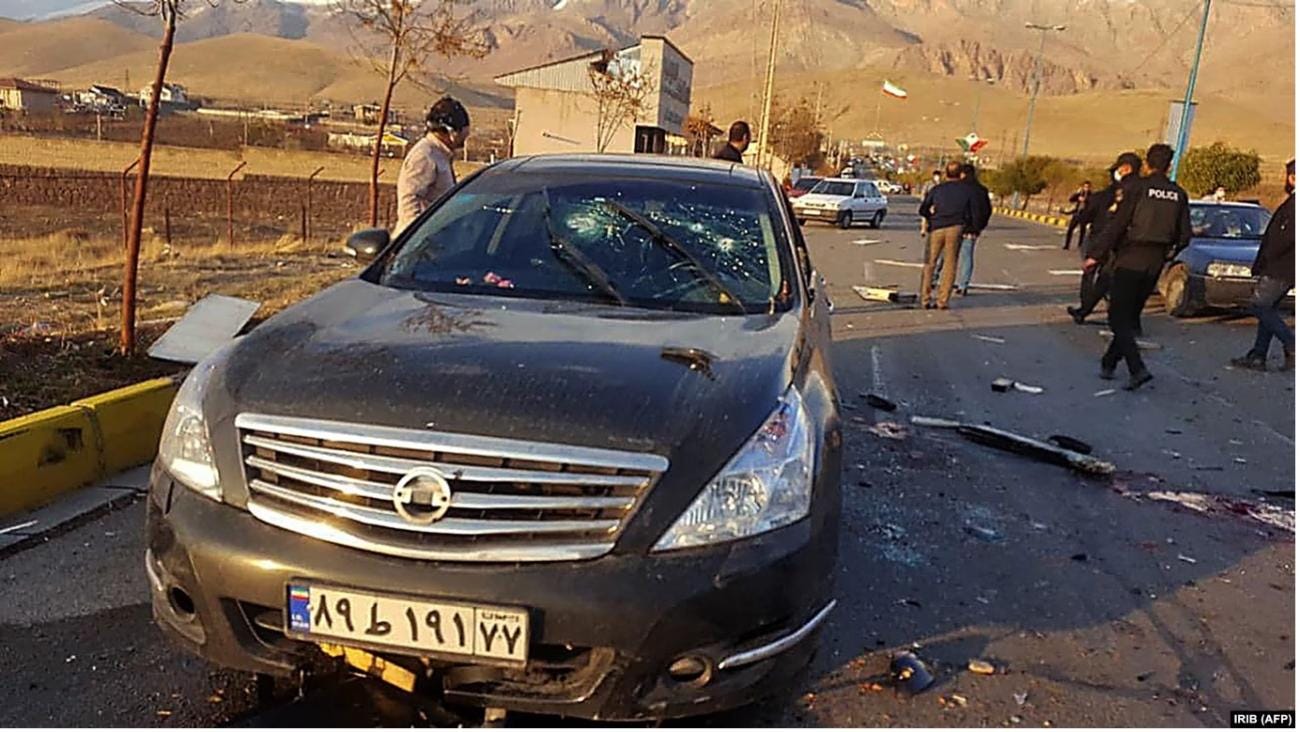
The car of Mohsen Fakhrizadeh after the Mossad assassination
In 2023, I travelled to Iran and filmed a documentary about what I saw on my travels. I visited the Museum of Holy Defense, which is devoted to telling the story of what we in the West call the Iran-Iraq war. In the museum, there was a display of the actual cars in which Iranian nuclear scientists had been assassinated by the Mossad, complete with bullet holes, the effects of the explosions, and, of course, blood stains. British intelligence maintained this pragmatic alliance with the Zionist entity on Iran, while privately warning that Mossad’s “twisted ideals and self-centred pragmatism” risked uncontrolled escalation.
GCHQ’s JTRIG Runs Online Deception Against Iran
The Joint Threat Response Intelligence Group (JTRIG) was a hitherto unknown propaganda department at GCHQ. Revealed by the Snowden leaks, it showed that JTRIG targeted the general population of Iran between 2009 and 2011 as part of GCHQ’s ‘Effects’ operations. The unit deployed techniques to discredit the Iranian leadership and its nuclear programme, disrupt the nuclear programme, conduct online human intelligence operations, and run counter-censorship campaigns. A 2011 JTRIG report explained that staff used methods “to discredit, disrupt, delay, deny, degrade, and deter” targets, including spreading negative information on blogs, to attack private companies and scupper business deals linked to Iran’s nuclear efforts.
MI6 and GCHQ Cyber Sabotage: The Stuxnet Operation
MI6 and GCHQ collaborated with the US and the Zionist entity on Stuxnet, the world’s first known digital weapon deployed against Iran’s nuclear programme, in 2010. GCHQ supplied critical intelligence that enabled the development of four zero-day exploits specifically tailored to sabotage the Natanz uranium enrichment facility, as revealed in the 2016 documentary Zero Days. The operation, code-named Olympic Games, involved British agencies providing technical support for the worm that destroyed thousands of Iranian centrifuges between 2007 and 2010. Following this, the UK intelligence agencies developed their first cybersecurity strategy. It was written in 2011 by Chloe Squires, an Oxbridge graduate who went straight into the Fast Stream of the civil service, presumably in MI6, since she subsequently worked for, or closely with, almost every single British intelligence agency. GCHQ targeted Iranian networks with cyber operations throughout the Stuxnet campaign, later expanding this work through the National Cyber Security Centre (NCSC) which Squires helped establish before being promoted to one of the UK’s top spy jobs: overseeing the Homeland Security Group in the Home Office. This also gave her oversight on covert propaganda with the Research, Information and Communications Unit. The work continued with the National Cyber Force (a partnership between the Ministry of Defence and police intelligence) launched in 2020, working alongside the NCSC, where Iran remains a primary target.
CSSF Iran Programme: FCDO-MI6 Intelligence Funding
The UK funnelled millions through the Conflict, Stability and Security Fund (CSSF) to counter alleged Iranian “hostile state activity”, citing Iranian cyberattacks on Albania as justification for regional programmes that disrupt Iranian-backed networks and proxies. Critics, such as Mark Curtis of Declassified UK, argue that the CSSF diverts aid money into opaque security operations which advance the UK’s national security goals against Iran while risking complicity in human rights abuses.
The UK channelled £2.5 million in non-ODA funding through the CSSF for its dedicated Iran Programme in the financial year 2021–2022. FCDO led the programme, which funded scoping work, JCPOA gap analysis, monitoring of Farsi open-source material, ad hoc reporting on internal Iranian policymaking, and continued support for the Instrument in Support of Trade Exchanges (INSTEX).
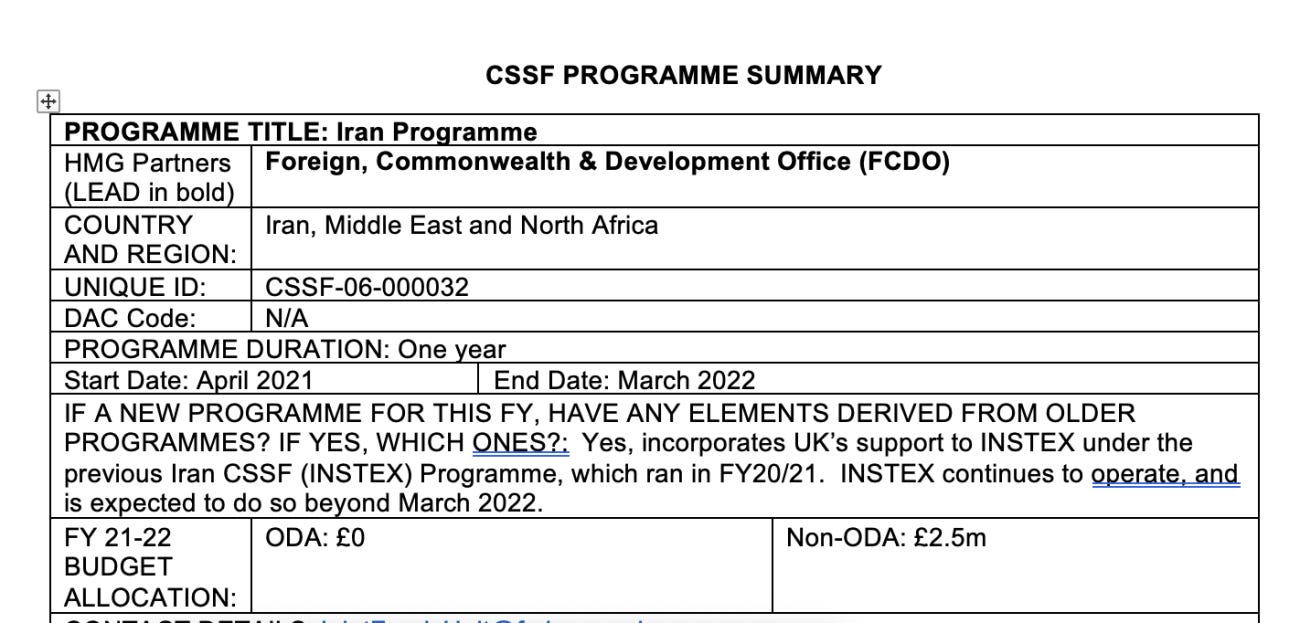
The MI6 project to subvert the Iranian nuclear programme
The CSSF operates under the direct oversight of the National Security Secretariat (NSS) and the National Security Council, making it intelligence-directed expenditure. Because MI6 sits within the FCDO structure, such CSSF programmes serve as convenient vehicles for British intelligence activities against Iran under the cover of diplomatic non-proliferation work.
UK’s Alleged IRGC Threat Campaign: 2023 Case
In December 2023, Magomed-Husejn Dovtaev was convicted of hostile reconnaissance at the then-Saudi funded propaganda channel Iran International’s London headquarters after allegedly filming security arrangements. Prosecutors linked the case to Iran, claiming it formed part of a broader plot. Dovtaev insisted he had been tricked into visiting the site to investigate a family fraud and described himself as a “useful idiot” set up by unknown contacts; his defence called the idea of an Iranian terror attack on a UK news outlet “far-fetched”. The arrest in this case is alleged to have led directly to the evacuation of Iran International from its London office and its relocation to the US. But the relocation was also precisely at the same time as another key event. Iran International has historically been funded by the Saudi regime and controlled by its Foreign Ministry, though it publicly denied these facts for a number of years.
All pretence was dropped, however, when China brokered a deal between Iran and Saudi Arabia revealed in early March 2023. One of the points of agreement was that Saudis would cease to fund the propaganda station. It looks like the money had already been pulled out by February 2023, when Iran International abruptly shut down under the cover of claims that the station had been ‘threatened’ by Iran — the far-fetched case just noted above. In August 2023, the channel confirmed it had already moved “to our new studios, where we have implemented bespoke security measures under Police guidance” in London, said Mahmood Enayat, General Manager of Volant Media, which runs the channel. The manufacture of fake claims about IRGC ‘threats’ appears to be central to the escalations against the Islamic Republic. It’s not clear in the 2023 case whether this was a Mossad or MI5 operation — or both.
The 2025 Escalation
By 2025–2026, the UK shifted from diplomatic management of Iran to large-scale counter-intelligence and active disruption of claimed Iranian state-backed hostile activity. While MI5 and police handle domestic operations on UK soil, MI6 supplies the foreign ‘intelligence’ on the IRGC that informs these actions.
The Government designated Iran under the Enhanced Tier of the Foreign Influence Registration Scheme (FIRS) from July 2025, requiring anyone acting for the Iranian state or IRGC to register activities to counter alleged Foreign Information Manipulation and Interference (FIMI). This has been used to directly target the TV show of which I am the producer and co-host, Palestine Declassified, with fanciful and false talk of a “spy hub” in the studio in which the show was produced in London. This is another indication of the motives behind all this: Zionist-inspired obsessions with crushing critics of Zionism. MI5 Director General Ken McCallum stated in October 2025 that British agencies had allegedly tracked more than 20 potentially lethal Iran-backed plots since 2022. Back in 2022, the Mossad claimed that it had tipped MI5 off about these plots.
This is, of course, all part of the relentless campaign by the Zionist regime to deflect the blame for aggression and violence away from its primary source: themselves. It is a mark of how docile MI5 now is in relation to the Mossad that such obvious lies are not only accepted, but then trumpeted in a propaganda announcement to the British public.
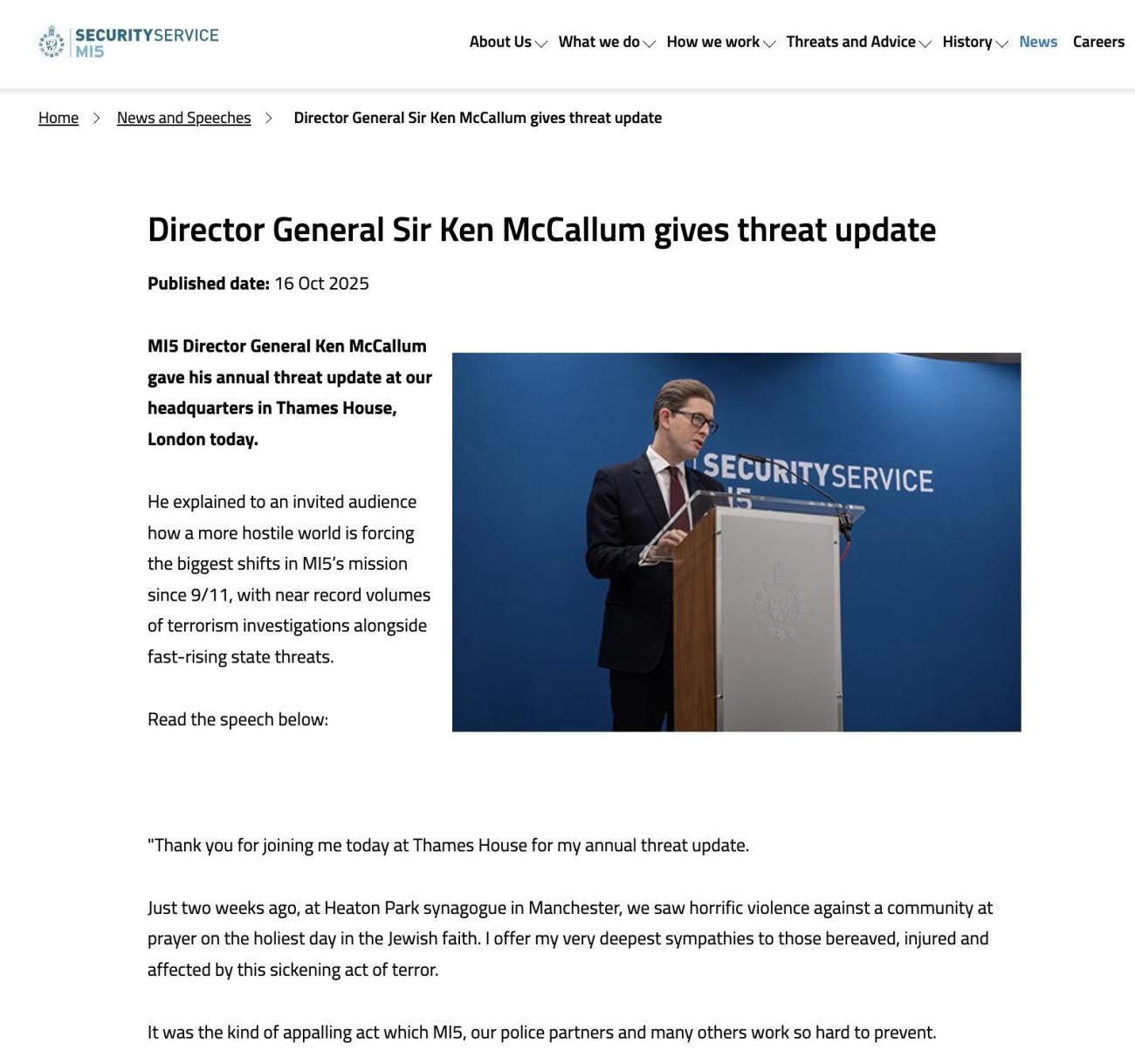
Ken McCallum of MI5 with a “threat update”
In January 2026, the UK Government stated it is “acting decisively to disrupt threats posed by Iran” and is developing new tools to designate state-linked organisations that “do us harm”.
The Government also expresses “concern” over what it calls “Iranian-aligned centres”, and the Charity Commission launched inquiries into the Islamic Centre of England and Al-Tawheed Charitable Trust, accused of acting as agents of influence. In reality, this is cover for direct attack on Shia Muslims.
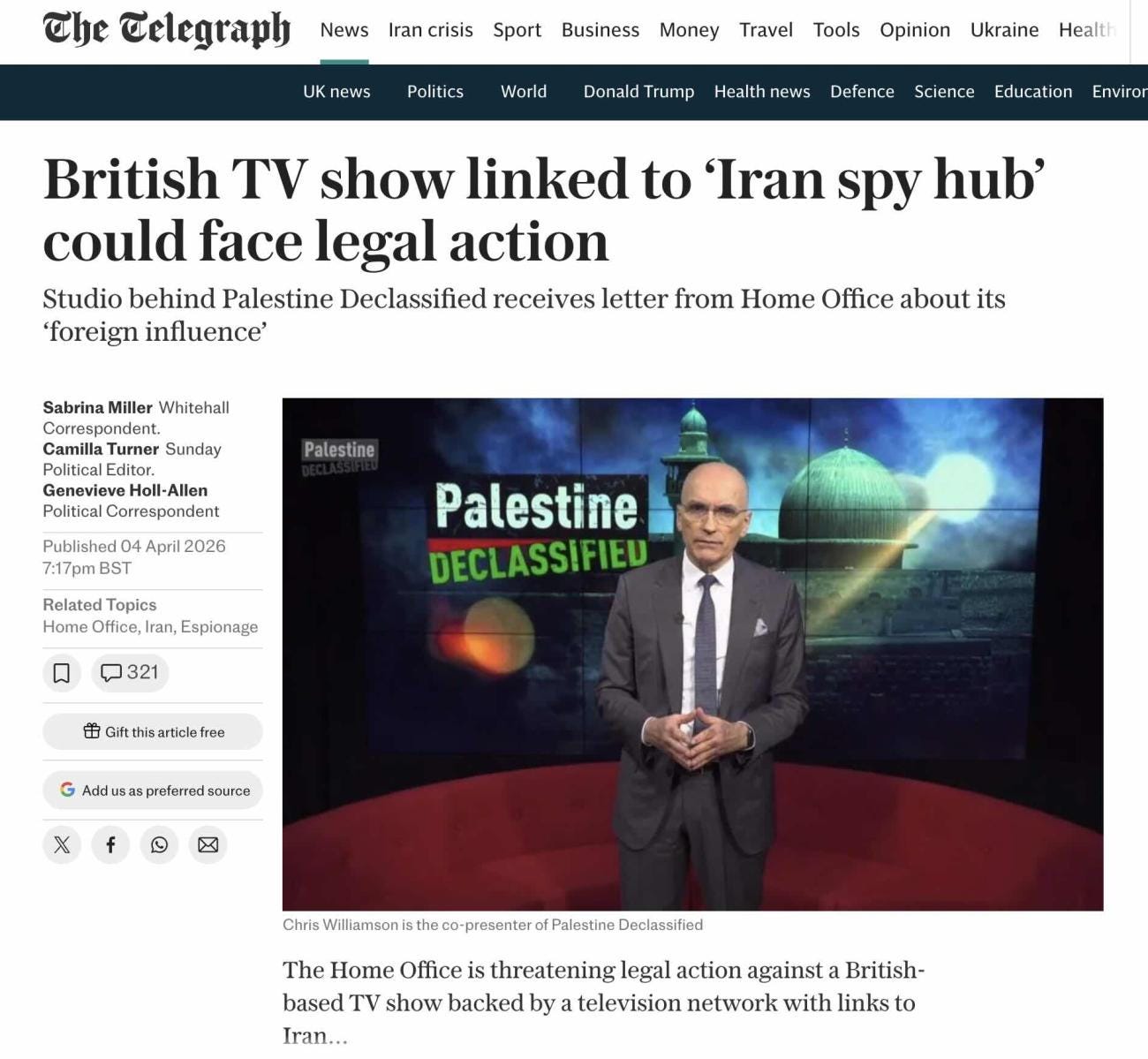
The Telegraph, encouraging fantasies about an ‘Iran spy hub’ in London
These regulatory actions targeting Shia institutions raise obvious questions about whether they function simply as propaganda tools to stigmatise Shia communities and justify wider measures against the IRGC. In retrospect, the preparation of the public mind for the idea of attacks by the IRGC in the UK has been mounting for some time. This raises suspicions that British intelligence agencies may have been involved in the false flag operation run by the Mossad in March and April this year, culminating in the arson attack on four ambulances in Golders Green, on which I have previously reported, which appears to have been a false flag.
Only 22 countries have never been invaded by Britain:
statista.com/chart/3441/countries-never-invaded-by-britain/
***
The U.S. is just the British Empire's nepo baby.
Pax Britannia became Pax Americana after WW2. It is all part of globalism (Imperialism) that was carried out by the fascists of the 19th-21st Centuries.
And nothing really changed since Palmerston, Milner and Halford Mackinder (The Imperialist "Heartland Theory")..
***
British and US establishments are closely intertwined, they're basically one and the same
substack.com/@beeley/note/p-164625270
***
Simply speaking, Brits are the wicked brain (Intelligence services/spy networks - colonial legacy) and the slush fund, and the U.S. is the brawn of the Global (Imperialist) Oligarchy.
youtube.com/watch?v=KaooeJzsRU8
***
CFR in the US and Chatham House in the UK. They are one and the same entity.
MI6 is part of "Five eyes". UK is a founding member of NATO.
Britain exerts influence through partial ownership of the FED. City of London is the headquarter of the global banking cartel. Besides, City of London basically runs all the main offshore funds.
AND It still runs Israel through the Pilgrim Society, Privy Council, RIAA, etc.
This is a forceful and, in many respects, compelling intervention that situates contemporary tensions with Iran within a much longer history of Western intelligence activity. Its greatest strength lies in drawing a clear through-line from the 1953 overthrow of Mohammad Mossadegh, a well-established joint operation involving MI6 and the CIA, to the present day. This context gives the broader argument real weight: it is difficult to dismiss claims of ongoing interference when there is such a clear precedent for it.
The piece is also effective in highlighting the structural nature of intelligence collaboration, particularly the long-standing relationship between British agencies and Mossad. By tracing these networks across decades, it builds a picture of continuity rather than isolated incidents, suggesting that what might appear as discrete operations are better understood as part of a sustained strategic alignment. Even where specific claims are harder to independently verify, the overall pattern it sketches is coherent and consistent with how intelligence alliances tend to operate.
Importantly, the article challenges the idea that Western states act primarily as neutral arbiters of security or stability. Instead, it reframes intelligence activity as a tool of geopolitical and economic power, often shielded from public scrutiny. That critique is not only legitimate but necessary, particularly given how rarely these institutions are subjected to meaningful democratic oversight.
At the same time, some sections would benefit from clearer distinctions between firmly evidenced claims and more interpretive conclusions. Personally, I think tightening that boundary make your claim harder to dismiss. As it stands, though, the piece succeeds in doing something valuable: forcing readers to reconsider comfortable narratives about Western foreign policy and to take seriously the possibility that much of what is presented as “defence” may in fact be projection of power. Brilliantly written and researched.