
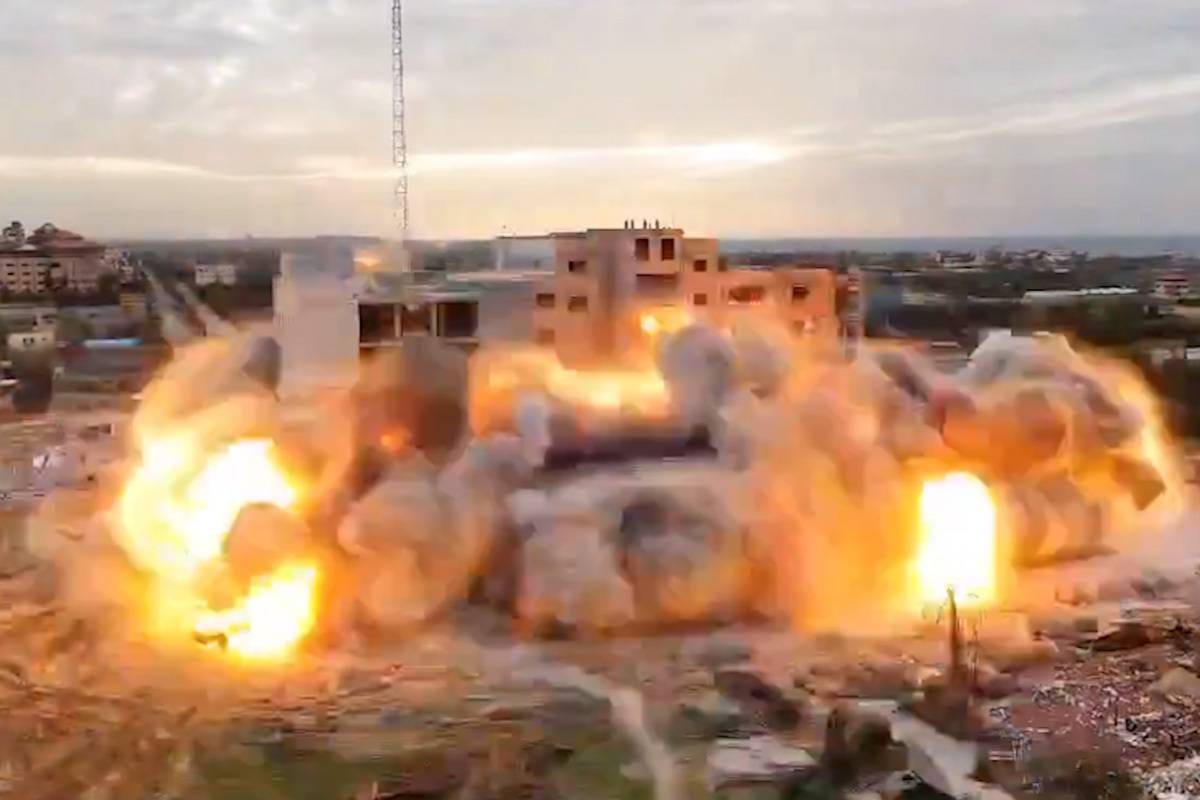
Three years after Al-Aqsa Flood, Gaza’s campuses are rubble. In the US, Britain, Australia and Canada the same war is being fought as a discipline case, an arms licence for a private guard, and a definition of antisemitism broad enough to criminalise anti-Zionism.
Scholasticide is the first fact
Start in Gaza, not in a dean’s office. A UNESCO assessment with the Ministry of Education and AWRAD, presented in November 2025, covered 21 higher-education institutions and 38 campuses. Twenty-two campuses were completely destroyed, 14 more were damaged, and 195 of 206 buildings were unusable. Of 5,102 staff, 1,112 had been killed, detained or injured. Islamic University, Al-Azhar, Al-Aqsa, Al-Israa: the sector as a physical fact had been hit.
That is scholasticide, a pillar of the genocide, not collateral. In July 2025 the presidents of Gaza’s universities wrote an open letter refusing a reconstruction designed by donors and occupiers. The Emergency Committee was set up mid-genocide to keep the institutions alive without their buildings. Academic freedom in Gaza is the freedom to teach in a tent because the campus was bombed. The West Bank is the same war at lower volume: raids on Birzeit, a campus treated as a security site. Every suspension in London or New York is downstream of that.
Textbooks, payroll, and the Gulf line
The same method, slower, runs through Yemen. Michigan State professor Shireen Al-Adeimi told Adnan Husain, in an interview carried by Drop Site on 5 October 2026, that new textbooks arrived one day “printed in Saudi Arabia instead of Egypt.” Saudi-backed Salafism had taken root around 1979, when Muqbil al-Wadi’i founded Dar al-Hadith in Dammaj, in the Zaidi stronghold of Saada. That push, she said, helped produce Ansar Allah.
The printing press was not only Riyadh’s. Arabic Post traced, the same week, how Israeli centres, above all IMPACT-se, have monitored curricula in 17 Arab countries for three decades and turned the files into donor pressure. In Saudi books the line “Muslims will not relinquish Jerusalem” was cut, and “the Zionist enemy” became “the Israeli occupation.” Yemen sits inside that net.
The war funded the policy rather than ending it. On 1 October 2026 Saudi Arabia and the UAE each put up $35 million for about 130,000 unpaid Yemeni teachers, via UNICEF. Okaz has Riyadh building 38 model schools and printing 2,548,852 textbooks. A teacher who cannot be paid except by Riyadh or Abu Dhabi does not set the curriculum.
The same states buy seats in Western knowledge: Middle East centres, language programmes, “tolerance” institutes. The colony’s campus network does the political work. In April 2024, I set out the spy side in the Israel on Campus Coalition, a private intelligence operation feeding universities and police the names of students. Gulf money and Zionist surveillance are not the same thing. But, they are the same refusal to let Arabs define Arabs.
Encampments, suspensions, guns
After the Flood the encampments made the link visible. Students occupied squares and demanded divestment from the arms firms bombing the universities UNESCO later counted. Columbia, UCLA and dozens of others were cleared by police; suspensions and visa threats followed the tents. In Australia the People’s Inquiry, launched in 2025, recorded facilities cut, security sent in to pressure protesters, and bans on “intifada”, “from the river to the sea”, and even the word genocide.
The armed turn should not be mis-described. It is not, on the evidence, a campus militia. It is a communal one, with a campus horizon. In July 2026 NSW deputy commissioner David Hudson told the Guardian that letting the Community Security Group carry guns would look like favouritism and would fracture relations the police were trying to hold. Premier Chris Minns kept the option open. On 21 August the NSW Greens said he was defying police and the Police Association, that CSG was already armed, and that its courses are run by agencies funded by the Israeli government. A tribunal, they said, had raised the question of allegiance to a foreign government.
Canada is on the same track. The Jerusalem Post reported B’nai Brith pressing for armed security at all Canadian Jewish institutions. The British equivalent is older: the Union of Jewish Students and the Community Security Trust as the accredited partners of universities. In May 2024 I argued for de-Zionising that franchise. A year on I wrote that the campus row was already a fight over who may name the colony. The guns are that fight leaving the seminar room.
Bristol, and what the law actually protected
I was sacked by the University of Bristol in October 2021 for anti-Zionist speech. The campaign to remove me was a Zionist one, run through complaints, financial threats, press and political pressure, the method later used on students in the encampments. In 2024 an employment tribunal found the dismissal unfair and discriminatory. On 4 August 2026 the Employment Appeal Tribunal dismissed most of the university’s appeal. Lord Fairley refused to strip the belief of protection because it was also political.
Jeanine Hourani wrote in The New Arab that the ruling puts anti-Zionism back in the antifascist tradition the Equality Act was built to hold. Anti-Zionism is a protected belief in Britain. A university that sacks for it is discriminating. That is the fight-back. It is a judgment, not a mood.
The American courts said the same thing
The US cases of 2025 and 2026 are the same judgment, reached against the plaintiffs who tried to make a slogan into a civil rights violation. On 19 March 2026 the Guardian counted a run of setbacks. The First Circuit threw out the Title VI case against MIT. The plaintiffs wanted “from the river to the sea” and “globalise the intifada” treated as attacks on Jewish students. The court refused. “We therefore reject plaintiffs’ claimed right to stifle anti-Zionist speech by labeling it inherently antisemitic.” They were “entitled to their own interpretive lens”. They were not entitled to bind anyone else to it.
Haverford’s keffiyeh claim went the same way: classic First Amendment expression. Penn’s case was dismissed. At worst, the judge found, Penn had tolerated viewpoints the plaintiffs disliked. Cooper Union lost most of its claims. Berkeley kept a narrower indifference file and lost the rest.
On 1 June 2026 the Southern District of New York went further. The Brandeis Center and Torridon Law had sued The People’s Forum and others over the April 2024 occupation of Hamilton Hall, as a civil-rights conspiracy. The court dismissed every federal claim with prejudice. “The choice to criticize Israel’s actions in Gaza does not necessarily manifest antisemitism.” The Jewish community itself, the judge noted, is divided on whether anti-Zionism is antisemitism. Leave to amend was refused as futile.
The bipartisan report, in a minority key
Read against those judgments, the document released in Washington on 28 September 2026 is not the opposite of the trend. It is the trend in a minority, institutional key. The US Commission on Civil Rights, led by Peter Kirsanow and Mondaire Jones, published a unanimous report calling campus antisemitism serious and growing and asking for more capacity to investigate. That is the harder hand. On the law, though, it is the same line the First Circuit and the Southern District had already drawn.
The Commission’s own summary says Title VI protects Jewish students on shared ancestry, not religion, and that current law distinguishes that from opposition to “Israel” or Zionism. Not every offensive incident is a violation. A bipartisan commission will not quote the MIT panel. It has still had to concede what that panel held: the politics are not the offence. Minimal. Real. The gap is where the IHRA fight sits.
The definition they want to make a crime
The IHRA working definition folds anti-Zionism into antisemitism by example: denying “the Jewish people” self-determination, by calling the settler colony a racist endeavour. The Antisemitism Awareness Act, H.R.1007 in the House and S.558 in the Senate, would direct the Department of Education to use that definition when the Office for Civil Rights investigates Title VI complaints. A 2019 executive order already told federal agencies to consider it. Dozens of states have written it into statute. A divestment motion can then be filed as harassment. That is the criminalisation: a definition, a funding lever, and a willing commission.
The Bristol ruling cuts the other way, and so do the American ones. If anti-Zionism is a protected belief, an IHRA policy that punishes it is an act of discrimination, not a safeguard. Gaza’s university presidents have already said what reconstruction without them would be. Three years on, the universities of Gaza are rubble, the textbooks of Yemen are printed in Riyadh and scrubbed by an Israeli monitor, and a private guard force in Sydney is being offered guns the police do not want it to have. The word for the colony is what they are trying to ban. A British tribunal, and a run of American courts, have protected it.
drone 5
https://substack.com/@tir1/note/c-366671801?r=qw38a
drone 1
Coming to your town soon.
Brought to you by the AI data centers of the global mafia of parasitic ashkenazi plutocrats.
We have the same usurping self-appointed rulers.
We're all Palestinians to them.
https://substack.com/@nsascancer/note/c-336847241?r=qw38a